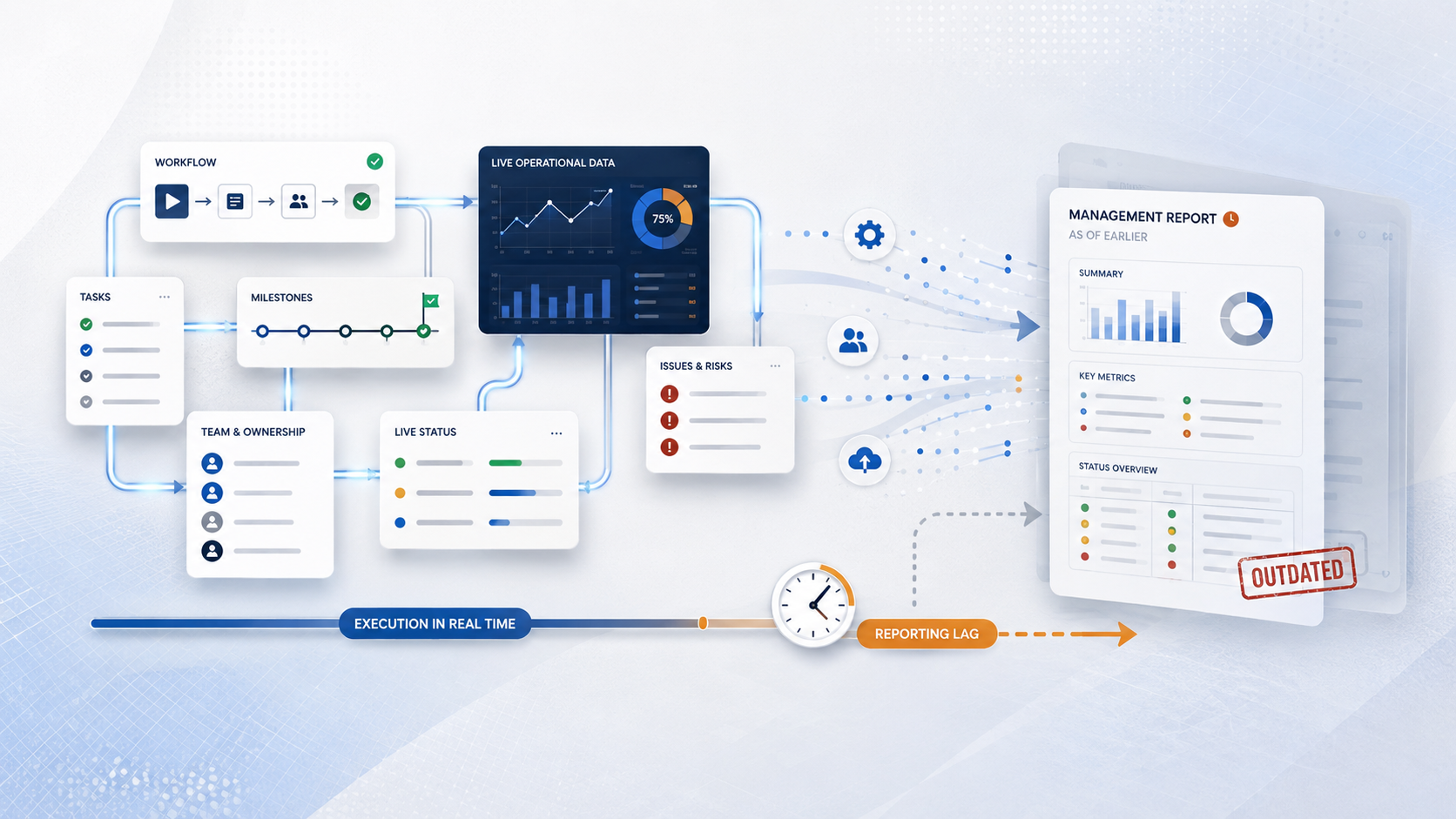
Project reporting is meant to create transparency. In practice, however, it often describes what has already happened rather than what is happening now.
The reason is simple: Reporting is frequently disconnected from execution. Teams update their operational systems, project managers collect status information, comments are requested, figures are reconciled and presentations are prepared. By the time the report reaches management, the underlying situation may already have changed.
The problem is therefore not reporting itself. It is the delay created when information has to be reconstructed after the work has happened.
A stronger approach is to generate relevant information as part of execution. Progress, responsibilities, issues, decisions and deviations should become visible while the work is being performed, not only when someone prepares the next status report.
This reduces manual consolidation and gives management a view that is closer to operational reality. It also allows project teams to spend less time reproducing information and more time managing the project itself.
Good reporting should not be a separate exercise. It should be a natural output of structured execution.
If your reporting process depends heavily on manual consolidation, the real issue may lie earlier in the way project information is created and connected.