From Understanding the Challenge to Sustainable Execution.
Aperta starts with the way your organisation actually works today.
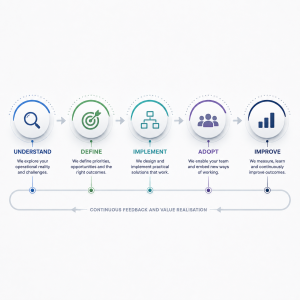
We first understand the operational challenge, then define what needs to change, translate the agreed model into structured execution, support adoption and use operational insight to continuously improve.
Our approach follows five connected steps:
UNDERSTAND → DEFINE → IMPLEMENT → ADOPT → IMPROVE
These steps are supported by our broader transformation model:
ENABLE → ELEVATE → EVOLVE
1. Understand the Challenge

Start with the problem, not with a predefined solution.
Before changing processes, structures or systems, we work to understand what is actually happening in your organisation.
We look beyond individual symptoms to understand where complexity, unclear responsibilities, fragmented information, inconsistent processes or weak governance are creating operational friction.
We explore
- Where does execution become difficult?
- Where is information fragmented or unreliable?
- Where are responsibilities unclear?
- Which processes are inconsistent?
- Where are risks or problems identified too late?
- Where does coordination consume unnecessary effort?
- Which governance mechanisms are difficult to maintain?
What this creates
- A shared understanding of the current situation
- Clearer priorities
- Identified root causes
- Defined improvement objectives
- A clear basis for deciding what should change
2. Define the Target Operating Model
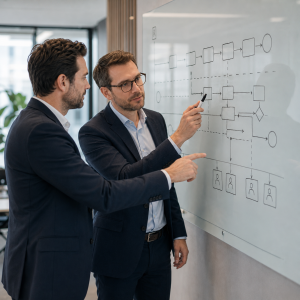
Define how work should be managed before digitalising it.
Once the challenge is understood, we define the structures required for more reliable execution.
This includes clarifying responsibilities, processes, information flows, decision paths and governance so that the intended way of working is understood before it is implemented.
We define
- Responsibilities and ownership
- Processes and workflows
- Decision and approval paths
- Required operational information
- Reporting and visibility requirements
- Governance principles
- Success criteria and expected outcomes
What this creates
- A clearly defined way of working
- Agreed responsibilities
- Common expectations across teams
- A practical governance model
- A clear foundation for implementation
3. Implement the Operating Model

Turn the agreed model into structured execution.
The defined operating model is translated into practical workflows, responsibilities, information structures and governance on the Aperta Platform.
The objective is not simply to digitalise existing administration. It is to create an environment in which the agreed way of working becomes easier to follow, more transparent and more reliable.
We implement
- Structured workflows
- Roles and responsibilities
- Project and process structures
- Operational information flows
- Governance and approval mechanisms
- Dashboards and reporting
- Required integrations and data connections
What this creates
- Consistent execution
- Clear operational ownership
- Shared information
- Embedded governance
- Better operational visibility
- A sustainable digital execution environment
4. Enable Adoption

A new way of working only creates value when people actually use it.
Implementation does not end when workflows and systems are configured.
We support the people who will work with the new model so that responsibilities are understood, processes are practical and the Platform becomes part of everyday execution rather than an additional administrative layer.
We support
- User onboarding
- Role-specific enablement
- Practical process adoption
- Leadership and stakeholder alignment
- Feedback from daily use
- Adjustment of workflows where required
What this creates
- Better acceptance of the new way of working
- Clearer expectations for users
- Fewer workarounds
- More consistent process execution
- A stronger foundation for sustainable adoption
5. Measure and Improve

Use actual execution to continuously improve the operating model.
Once structured execution is established, the organisation begins to generate more consistent operational information.
This information can be used to understand performance, identify recurring problems, recognise deviations and continuously improve processes, governance and decision-making.
We review
- Operational performance
- Risks and recurring issues
- Process effectiveness
- Governance effectiveness
- Workload and execution patterns
- Opportunities for automation and analytics
- Opportunities to extend Platform use cases
What this creates
- Continuous operational insight
- Earlier recognition of improvement opportunities
- Evidence-based process improvement
- Stronger governance maturity
- More predictable execution
- A continuously improving operating model
Start Small.
Create Value.
Expand with Confidence.
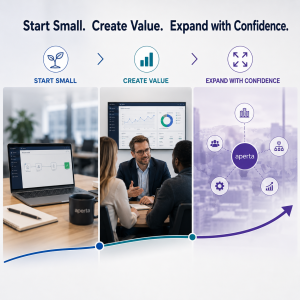
Transformation does not need to begin with a large organisation-wide programme.
Aperta can start with a clearly defined operational challenge or first use case where value can be demonstrated in practice.
Once the approach is working, the operating model and the Aperta Platform can be extended to additional processes, projects, teams or organisational areas.
The objective is controlled progress: Create clarity, establish a working solution, demonstrate value and expand from a proven foundation.
Where Should Your Transformation Start?
You do not need to have the solution already defined.
If you know where execution is creating friction, we can start there.
If the problem itself is still unclear, we can help create the clarity needed to identify the right first step.