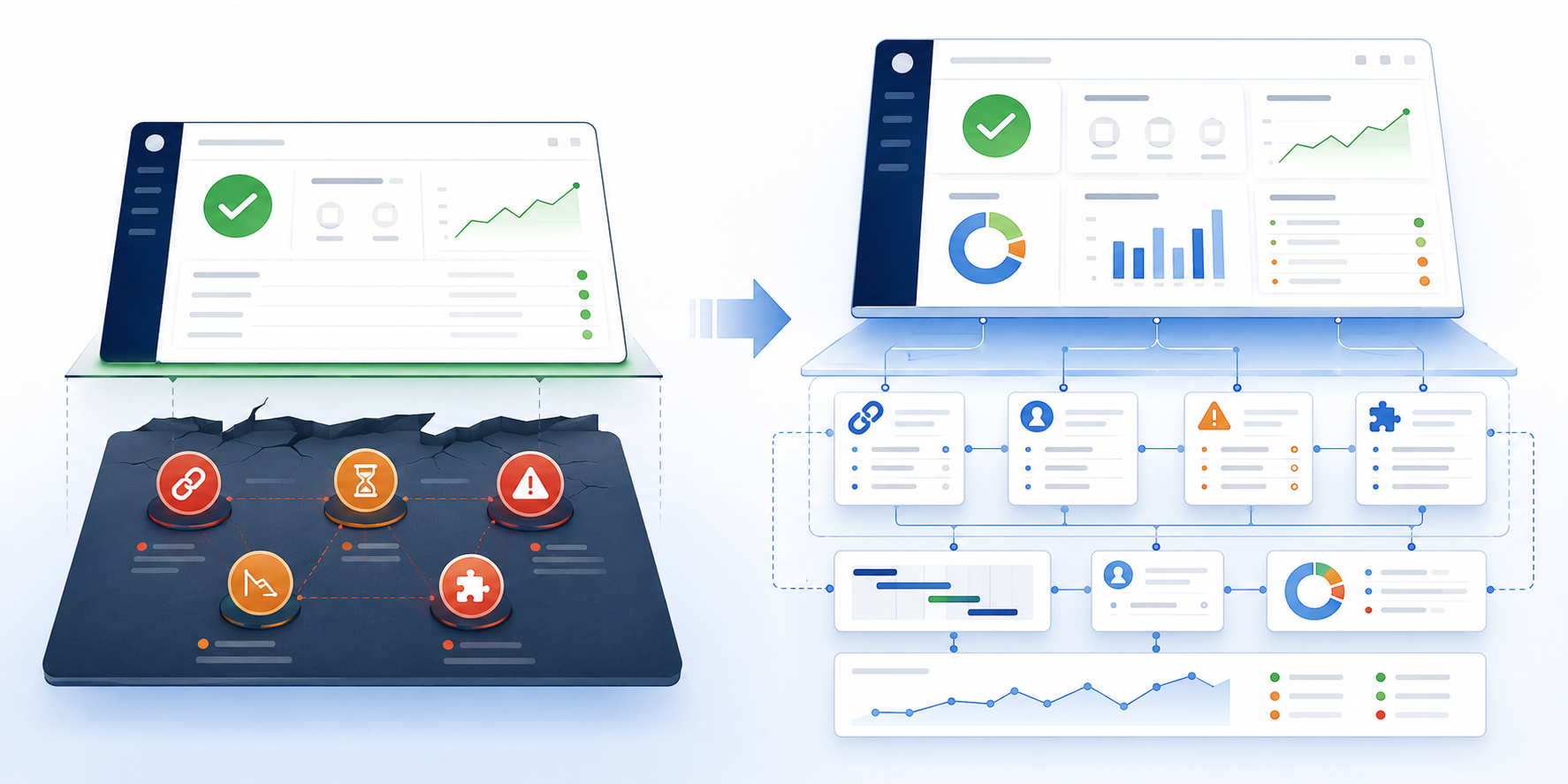
Many projects look healthy for most of their lifecycle. The status report says green, the steering committee sees progress, and the project plan is updated. There may be open points, delayed decisions or known risks, but nothing seems critical enough to change the overall picture – until suddenly, it does.
A missed milestone becomes visible. A dependency was not resolved. A risk turns into an issue. What looked like a controlled project is now under pressure.
In many organizations, this does not happen because people do not care. It happens because project visibility is often built on reporting cycles, personal interpretation and fragmented information. Updates are collected from different sources. Teams work in separate tools. Decisions are documented in emails or meeting notes. Risks are known locally, but not always connected to the management view.
By the time the status turns red, the organization is no longer looking at an early warning. It is looking at the consequence.
This is the weakness of status reporting when it is disconnected from execution. A green status is only useful if it reflects the actual state of the work. That requires more than a traffic light in a report. It requires structured processes, clear responsibilities, visible dependencies and a shared understanding of what “on track” really means.
Aperta helps to close the gap between reported status and operational reality.
The Aperta Platform connects project processes, responsibilities, tasks, decisions, risks and management visibility within a shared execution environment. Instead of relying only on periodic updates, teams and managers can work from a more integrated view of what is actually happening.
This does not remove the need for judgement. But it gives judgement a better foundation. Because projects rarely fail in one dramatic moment. They usually drift first. Signals appear, decisions wait, responsibilities blur, dependencies move, and if those signals remain scattered, the project can still look green long after the situation has changed.
The goal is not to make every project look perfect. The goal is to make the real situation visible early enough to act.
How does your organization know whether a project is truly on track, and where could better structure, transparency and visibility support better conversations before problems become critical?