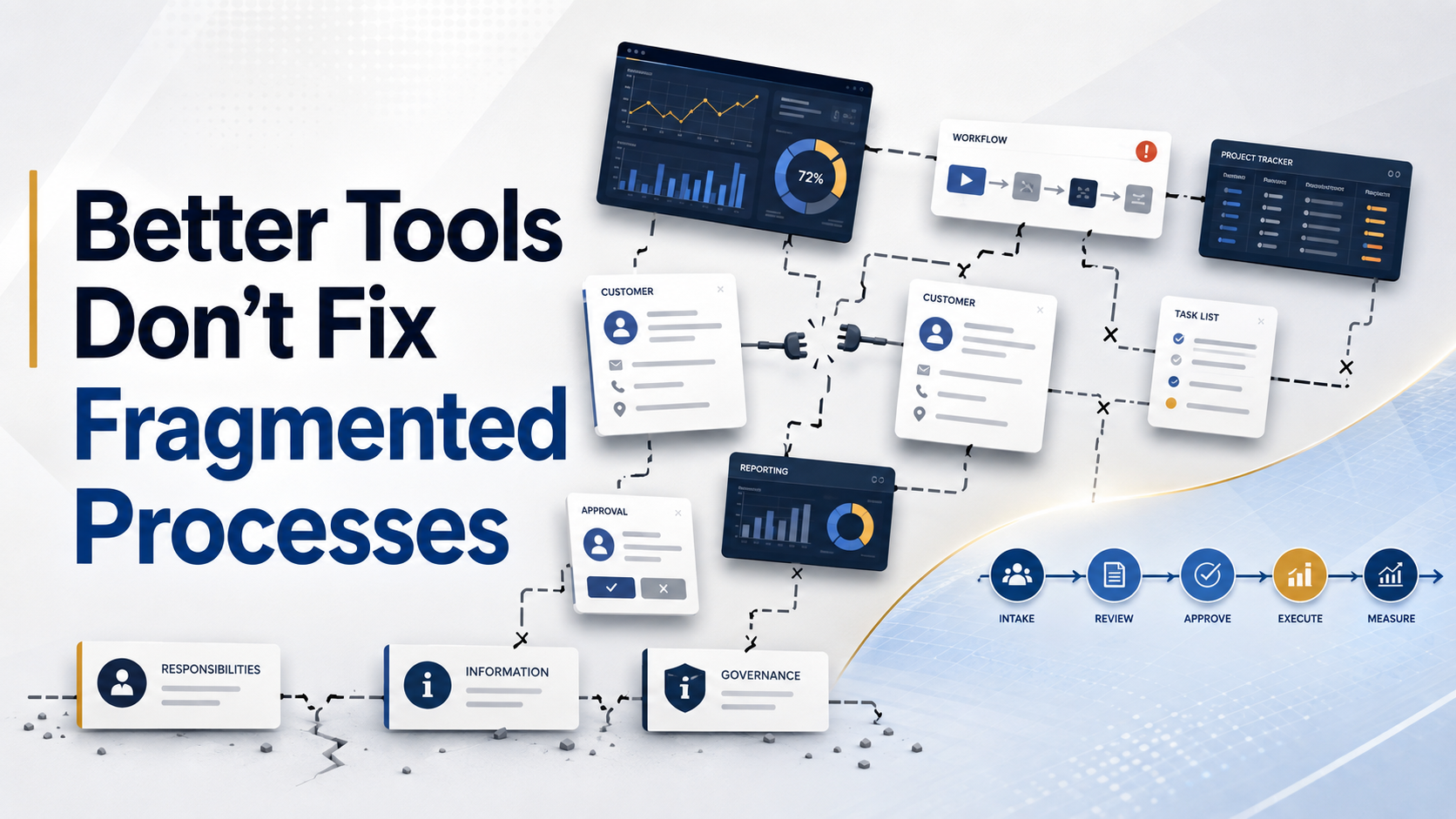
When execution becomes difficult, organisations often look for another tool: A new project-management system, reporting solution, dashboard or collaboration platform.
Sometimes that helps. But often the underlying problem is not the tool itself. It is the fragmentation around it.
Processes are documented in one place, responsibilities discussed somewhere else, project information spread across several systems and management reporting reconstructed afterwards. Each individual tool may work well, while the organisation still struggles to maintain a reliable view of what is actually happening.
The problem often exists between the tools.
Adding more technology can even increase coordination effort when information needs to be copied, reconciled or repeatedly explained across systems.
A better starting point is therefore to clarify the operating model first: How should the work actually be executed? Who owns which responsibility? Which information is required? How are decisions, deviations and governance handled?
Technology can then reinforce that structure rather than compensate for its absence.
This is becoming even more important with AI. AI depends on reliable information, clear context and defined governance. Fragmented execution does not automatically become structured simply because AI is added to it.
Better technology matters. But sustainable improvement starts by connecting processes, responsibilities, information and governance.
That is how better tools become better execution.
Is fragmentation creating unnecessary complexity in your organisation?